
Project Overview
History: How We Got Here
For decades, Aspen has worked to improve how people travel and commute on the CO 82 corridor and into town.
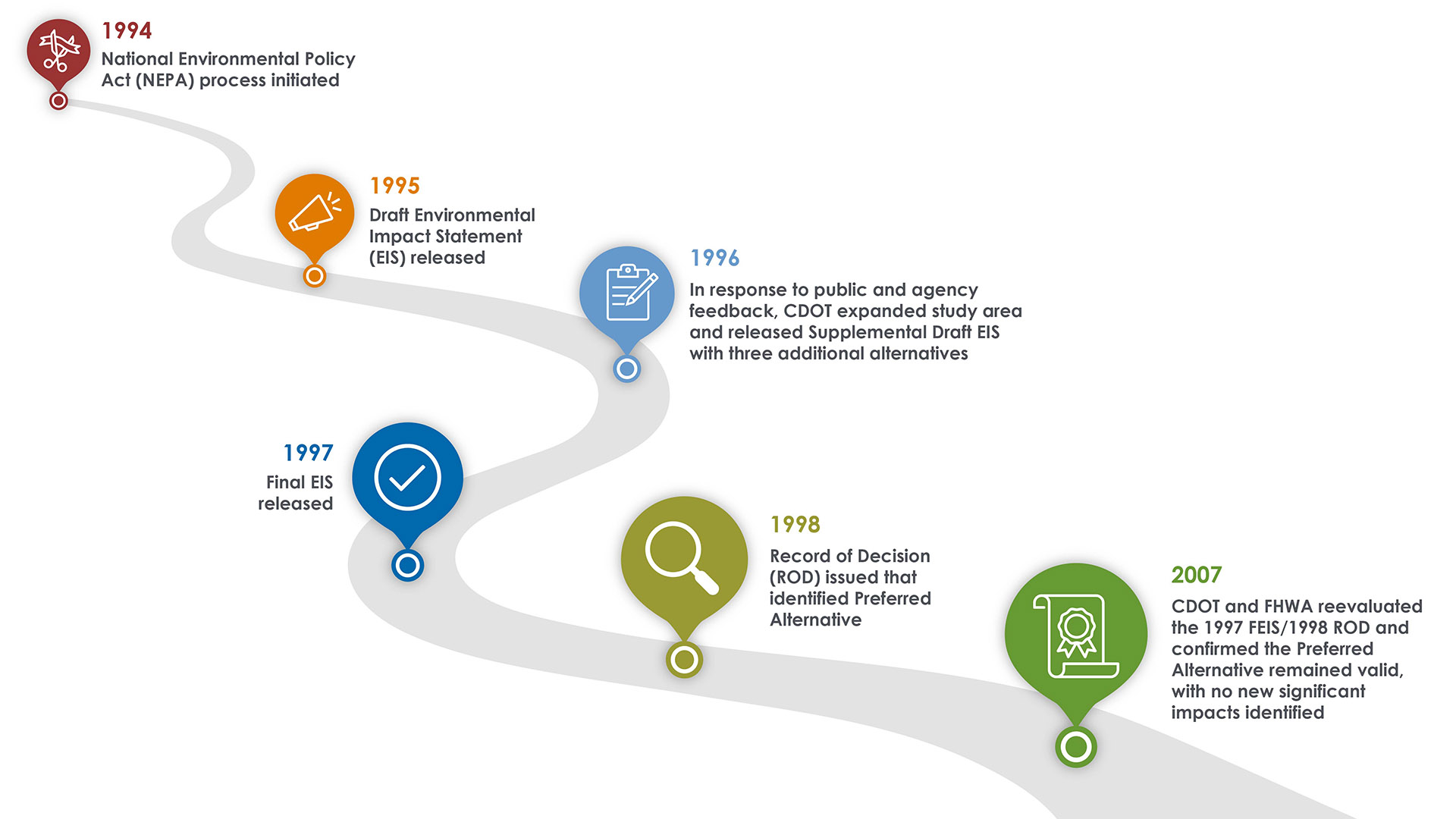
In the 1990s, the City of Aspen, Colorado Department of Transportation (CDOT), the Federal Highway Administration (FHWA), as well as the community at large began a major planning effort to improve transportation, safety and mobility on the CO 82 corridor.
This project is guided by technical documents known as the 1997 Environmental Impact Statement (EIS) and its 1998 Record of Decision (ROD), which selected the Preferred Alternative among more than 40 options. These documents established the federally approved design under the National Environmental Policy Act (NEPA).
The graphic below shows the milestones of the National Environmental Policy Act (NEPA) process.
What is NEPA?
NEPA is a federal law that requires federal government agencies to evaluate the environmental impacts of proposed projects before making decisions. This process helps ensure that environmental factors such as effects on air, water, wildlife, and communities, are considered in the decision-making process. NEPA also provides opportunities for public input, allowing community members to learn about and comment on projects that may affect them.

The Record of Decision and Preferred Alternative
After evaluating more than 40 different alternatives as part of this multi-year process, the agencies and the community selected one, known as the Preferred Alternative. It is part of a larger document called the Record of Decision (ROD) that was finalized in 1998 and includes:
- Highway and Intersection Improvements
- New Transit System
- Transportation Management Programs
- And more
What’s Been Built Since Then?
Various components of the 1998 plan have been implemented over the years, including replacement of the Maroon Creek Bridge, the construction of a roundabout to improve traffic flow, the realignment of Owl Creek Road, a westbound bus lane downtown, and transportation demand management measures including parking management and improved transit service.
The 2007 Reevaluation
In 2007, a NEPA reevaluation revisited the 1998 ROD using updated traffic, safety, and environmental data. That process concluded that the original plan remained valid under current conditions, meaning no major rework was needed then.
What Still Remains?
While many pieces of the 1998 plan are complete, the new Castle Creek Bridge and the realigned Highway 82 portion were never built. Over time, the existing bridge has been maintained, and the city and agencies have continued to evaluate design, funding, and community priorities for implementation.
Why Now, Again?
Aspen faces growing transportation pressures. The 60-year-old Castle Creek Bridge is aging; wildfire risk heightens the need for reliable emergency access, and congestion remains a daily challenge. Recent community and government agency decisions reaffirm support for moving the long-standing Entrance to Aspen plan forward. The next step is to confirm that the 1998 Preferred Alternative still works today, or if it needs minor refinement or additional environmental study (Supplemental Environmental Impact Statement known as an SEIS).
Purpose & Need + Project Objectives
Last year, the City, in coordination with CDOT and FHWA, took a fresh look at the project purpose, needs and objectives through data collection and public and stakeholder engagement.
The purpose of the project, identified in the 1990s, is to develop a transportation solution that will improve transportation and safety along the CO 82 corridor between the airport and Aspen while avoiding or minimizing adverse environmental effects.
The stated purpose of the project from the EIS remains unchanged.
Upon recent review, the project needs and objectives remain very similar to those that were established in the 1990s. However, the transportation needs documented in the EIS do not reflect current conditions in some instances and contain some outdated information. For example, impediments to carpooling and transit deficiencies that may reduce transit use, which have been identified as current corridor issues, were not needs identified in the EIS. Additionally, specific safety issues, traffic bottlenecks, and bike/ped facility gaps have changed.
Studies are underway to document current conditions in the corridor. This information will be used to make minor refinements to the transportation needs from the EIS, which documented the following types of needs in the corridor:
- System Relationships
-
Highway 82 is the only major route into Aspen, connecting to regional and interstate systems.
-
Limited redundancy means any disruption (weather, accidents) severely impacts mobility.
-
The corridor must integrate with local transit and regional transportation plans.
-
- Traffic Characteristics
-
High seasonal variation: winter ski season and summer tourism create peak congestion.
-
Daily commuter traffic from down-valley communities adds pressure.
-
Existing roadway geometry (S-curves) constrains flow and limits capacity.
-
- Safety
- Crash rates in the corridor exceed statewide averages for similar facilities.
- Narrow lanes, sharp curves, and limited sight distance contribute to accidents.
- Emergency access is constrained during peak periods, affecting response times.
- Economic Conditions
- Aspen’s economy depends on reliable access for tourism and workforce commuting.
- Congestion and delays affect local businesses and visitor experience.
- Transportation inefficiencies increase costs for goods and services delivered to Aspen.
Community Objectives
Ten project objectives were developed as part of the public and agency scoping process conducted during the EIS. The objectives were developed based on known CO 82 problems and concerns and corresponding issues raised by the Aspen area community. Consensus on the objectives was developed from the affected agencies, elected officials and staff of area governments, and concerned members of the public. These objectives incorporate the project needs mentioned above and must be met by the proposed transportation improvements.
Project Objectives from EIS
| Category | Objective |
|---|---|
| Transportation Capacity | Provide needed transportation capacity for forecasted 2015 trips |
| Limit AADT to 1993 levels at the Castle Creek Bridge, and strive to reduce peak-hour vehicle trips to at or below 1993 levels | |
| Community Based Planning | Limit vehicle trips into downtown Aspen to create a less congested downtown core |
| Provide reliable travel times to and from Aspen | |
| Safety | Reduce high accident rate on CO 82 |
| Provide safety improvements for bicycles and pedestrians | |
| Provide safe access at all intersections for all movements | |
| Environmentally Sound Alternative | Ability to minimize and mitigate adverse impacts |
| Community Acceptability | Fits the character of the community and is aesthetically acceptable to the public |
| Financial Limitations | Financially realistic with respect to current and expected funding levels and programs |
| Clean Air Act Requirements | Ability to demonstrate conformity |
| Emergency Access and Evacuation | Provides alternate route for emergency response and evacuation |
| Facilities improved emergency response and faster emergency evacuation | |
| Livable Communities | Reflects small town character and scale of Aspen community |
| Provides more accessible transportation and increases the mobility of the community | |
| Phasing | Allows for future transit options and upgrades |
Community Involvement
Starting in the mid-nineties, hundreds of community members have worked tirelessly to address traffic congestion and improve air quality through plans for a different Entrance to Aspen. This early work was used by CDOT as the foundation to create the project objectives mentioned above. Since then, public comment/input has been solicited through public meetings, open houses, small groups, workshops, and hundreds of letters.
Staying true to this dedication to the public process, the reevaluation follows a Context Sensitive Solutions approach—a collaborative process that brings together community values, environmental stewardship, and transportation needs. The project team will engage with various stakeholders and the public to ensure that all voices are heard, and decisions reflect the character and priorities of Aspen and the surrounding region.
Contact Us: Emily Ford, City of Aspen Communications Specialist: info@entrancetoaspen.co
Copyright ©2025 City of Aspen, Colorado. All Rights Reserved.